Deep time
Before history, the rocks.
The subcontinent's story begins long before people: a fragment of Gondwana carrying dinosaurs north across the ocean, the vast Deccan eruptions, the first whales on the shores of a vanished sea, apes in the Himalayan foreland — and, much later, the first stone tools and the Narmada skull cap.
Jurassic
201 million years ago – 145 million years ago
Cretaceous
145 million years ago – 66 million years ago
Paleogene
66 million years ago – 23 million years ago
Neogene
23 million years ago – 2.6 million years ago
Pleistocene
2.6 million years ago – 12,000 years ago
The Map Check
Where the evidence lies
Fossil and early stone-tool sites with published dates. Locations are approximate to the formation or valley.
Chronology
Oldest to youngest
Early Jurassic (c. 190–180 million years ago; age debated)
Kota Formation (Barapasaurus)Early Jurassic rocks of the Pranhita–Godavari valley that yielded Barapasaurus tagorei, one of the earliest known sauropod dinosaurs, from several partial skeletons.
Well supportedJain et al. 1975c. 190–180 million years ago
Early sauropods in Gondwanan IndiaBarapasaurus and other early dinosaurs live in the river valleys of the Kota Formation, when India was part of Gondwana.
Well supportedJain et al. 1975Late Cretaceous (Maastrichtian), c. 70–66 million years ago
Jabalpur (Bara Simla hill)The first dinosaur bones reported from India were found here in 1828 by William Sleeman; Richard Lydekker later named Titanosaurus indicus from Jabalpur material.
Well supportedLydekker 1877Late Cretaceous (Maastrichtian)
Rahioli (Balasinor dinosaur site)Lameta Formation beds in Gujarat with abundant dinosaur eggs and the remains of Rajasaurus narmadensis, a horned abelisaurid predator.
EstablishedWilson et al. 2003Late Cretaceous
Bagh–Kukshi titanosaur nesting groundsNinety-two nesting sites with 256 titanosaur eggs reported from the Lameta Formation of the lower Narmada valley — evidence of colonial nesting by giant sauropods.
Well supportedDhiman et al. 2023c. 66 million years ago
Deccan Traps eruptions and the end-Cretaceous extinctionVast basalt eruptions form the Deccan Traps around the time of the extinction that ended the age of dinosaurs, 66 million years ago.
EstablishedSchoene et al. 2019Early Eocene, c. 50 million years ago
Chorlakki (Pakicetus)Early Eocene river deposits in northern Pakistan that yielded Pakicetus, a land-dwelling early whale relative.
EstablishedGingerich et al. 1983c. 50–47 million years ago
Whales begin on the shores of TethysPakicetus and Indohyus show whales evolving from land mammals along the coasts and rivers of the closing Tethys sea.
EstablishedGingerich et al. 1983Middle Eocene, c. 48 million years ago
Kalakot (Indohyus)Eocene rocks in Jammu that yielded Indohyus, a small deer-like semi-aquatic mammal identified as the closest known relative of whales.
EstablishedThewissen et al. 2007Middle–Late Miocene; the specimen's own age is not confirmed here
Potwar Plateau (Sivapithecus)Miocene Siwalik deposits that produced the Sivapithecus face GSP 15000, which linked this ape to the orangutan lineage. The specimen is assigned to Sivapithecus indicus, a species dated to roughly 12.5–10.5 million years ago.
EstablishedPilbeam 1982c. 12.5–8 million years ago
Apes of the SiwaliksSivapithecus lives in the forests of the Himalayan foreland.
EstablishedPilbeam 1982c. 2.6 million years ago (claim debated)
Masol (Quranwala zone)Siwalik fossil beds where bovid bones with marks interpreted as butchery cut marks were dated to about 2.6 million years ago — a claim of very early hominin presence that is strongly debated.
DebatedDambricourt Malassé et al. 2016c. 1.9 million years ago (claim debated)
RiwatA site in the Soan valley where flaked quartzite pieces were reported from deposits dated to about 1.9–2 million years ago — another debated early-tool claim.
DebatedDennell et al. 1988c. 1.5 million – 170,000 years ago
AttirampakkamAn open-air Palaeolithic site near Chennai that has produced some of the oldest dated Acheulian stone tools in South Asia, and later Middle Palaeolithic assemblages.
Well supportedPappu et al. 2011c. 1.5 million years ago
Acheulian toolmakers in South IndiaBurial dating at Attirampakkam places Acheulian stone tools at around 1.5 million years ago.
Well supportedPappu et al. 2011c. 1.2 million years ago
IsampurAn Acheulian quarry-workshop in the Hunsgi valley where handaxe makers exploited limestone blocks, dated to about 1.2 million years ago.
Well supportedPaddayya et al. 2002Middle–Late Pleistocene; reworked gravels, minimum c. 49,000 years, maximum uncertain
Hathnora (Narmada hominin)Where Arun Sonakia of the Geological Survey of India found a fossil human skull cap in Narmada valley gravels in 1982 — the only fossil cranium of an archaic (pre-modern) human yet found in South Asia.
EstablishedSonakia et al. 1985Acheulian deposits to the historical period
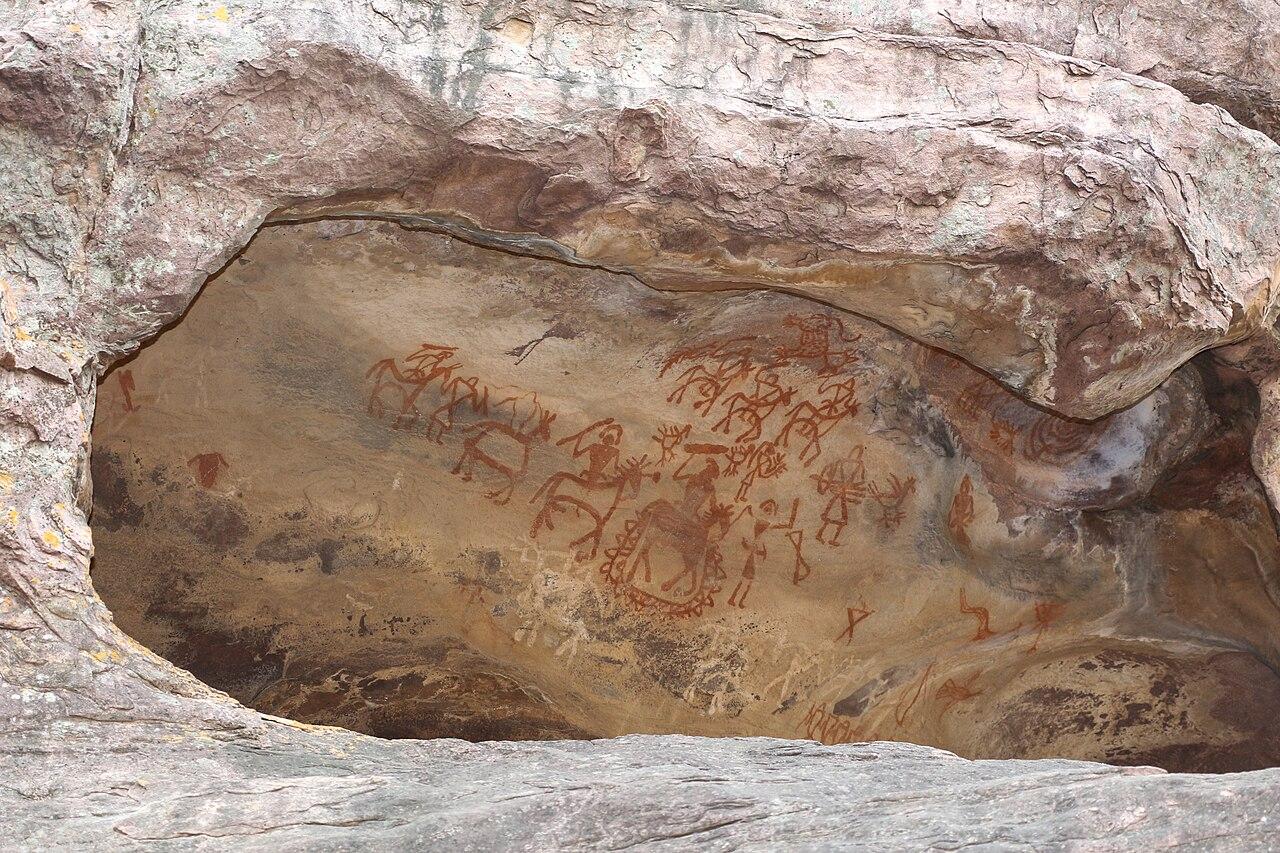
BhimbetkaA dense cluster of sandstone rock shelters in the foothills of the Vindhyas, with stone-tool deposits reaching back to the Acheulian and paintings spanning from the Mesolithic into historical times.
EstablishedUNESCO World Heritage Centre 2003c. 80,000 – 65,000 years ago
DhabaA site in the Middle Son valley with a stone-tool sequence spanning about 80,000 to 65,000 years ago, across the Toba eruption.
Well supportedClarkson et al. 2020c. 77,000 years ago onward
JwalapuramSites in the Jurreru valley where Middle Palaeolithic tools lie both below and above the ash of the Toba super-eruption (c. 74,000 years ago), suggesting people persisted through it.
Well supportedPetraglia et al. 2007c. 74,000 years ago
Toba super-eruptionA massive eruption in Sumatra deposited ash across South Asia; its effect on human populations is debated.
EstablishedConingham et al. 2015Dry land in the last ice age; drowned c. 6000 – 4500 BCE
Land link between India and Sri LankaThe sea between India and Sri Lanka is shallow; Adam's Bridge is a chain of shoals only a few metres deep. While sea level stood lower in the last ice age, the two were one landmass. In the coastline model used on this atlas, the link is cut once the sea rises to between about 10 and 5 metres below today, which the sea-level curve places roughly 8,000 to 6,500 years ago.
Well supportedSpratt et al. 2016c. 48,000 years ago onward
Fa-Hien LenaA large rainforest cave in south-western Sri Lanka with evidence of Homo sapiens from around 48,000 years ago, including specialised hunting of monkeys and squirrels.
Well supportedWedage et al. 2019c. 48,000 – 45,000 years ago
Modern humans in Sri Lanka's rainforestsFa-Hien Lena preserves evidence of Homo sapiens hunting monkeys and squirrels in rainforest around 45,000 years ago.
Well supportedWedage et al. 2019
Sites
Fossil and early archaeological sites
Kota Formation (Barapasaurus)
Early Jurassic rocks of the Pranhita–Godavari valley that yielded Barapasaurus tagorei, one of the earliest known sauropod dinosaurs, from several partial skeletons.
Jabalpur (Bara Simla hill)
The first dinosaur bones reported from India were found here in 1828 by William Sleeman; Richard Lydekker later named Titanosaurus indicus from Jabalpur material.
Rahioli (Balasinor dinosaur site)
Lameta Formation beds in Gujarat with abundant dinosaur eggs and the remains of Rajasaurus narmadensis, a horned abelisaurid predator.
Bagh–Kukshi titanosaur nesting grounds
Ninety-two nesting sites with 256 titanosaur eggs reported from the Lameta Formation of the lower Narmada valley — evidence of colonial nesting by giant sauropods.
Chorlakki (Pakicetus)
Early Eocene river deposits in northern Pakistan that yielded Pakicetus, a land-dwelling early whale relative.
Kalakot (Indohyus)
Eocene rocks in Jammu that yielded Indohyus, a small deer-like semi-aquatic mammal identified as the closest known relative of whales.
Potwar Plateau (Sivapithecus)
Miocene Siwalik deposits that produced the Sivapithecus face GSP 15000, which linked this ape to the orangutan lineage. The specimen is assigned to Sivapithecus indicus, a species dated to roughly 12.5–10.5 million years ago.
Masol (Quranwala zone)
Siwalik fossil beds where bovid bones with marks interpreted as butchery cut marks were dated to about 2.6 million years ago — a claim of very early hominin presence that is strongly debated.
Riwat
A site in the Soan valley where flaked quartzite pieces were reported from deposits dated to about 1.9–2 million years ago — another debated early-tool claim.
Attirampakkam
An open-air Palaeolithic site near Chennai that has produced some of the oldest dated Acheulian stone tools in South Asia, and later Middle Palaeolithic assemblages.
Isampur
An Acheulian quarry-workshop in the Hunsgi valley where handaxe makers exploited limestone blocks, dated to about 1.2 million years ago.
Hathnora (Narmada hominin)
Where Arun Sonakia of the Geological Survey of India found a fossil human skull cap in Narmada valley gravels in 1982 — the only fossil cranium of an archaic (pre-modern) human yet found in South Asia.
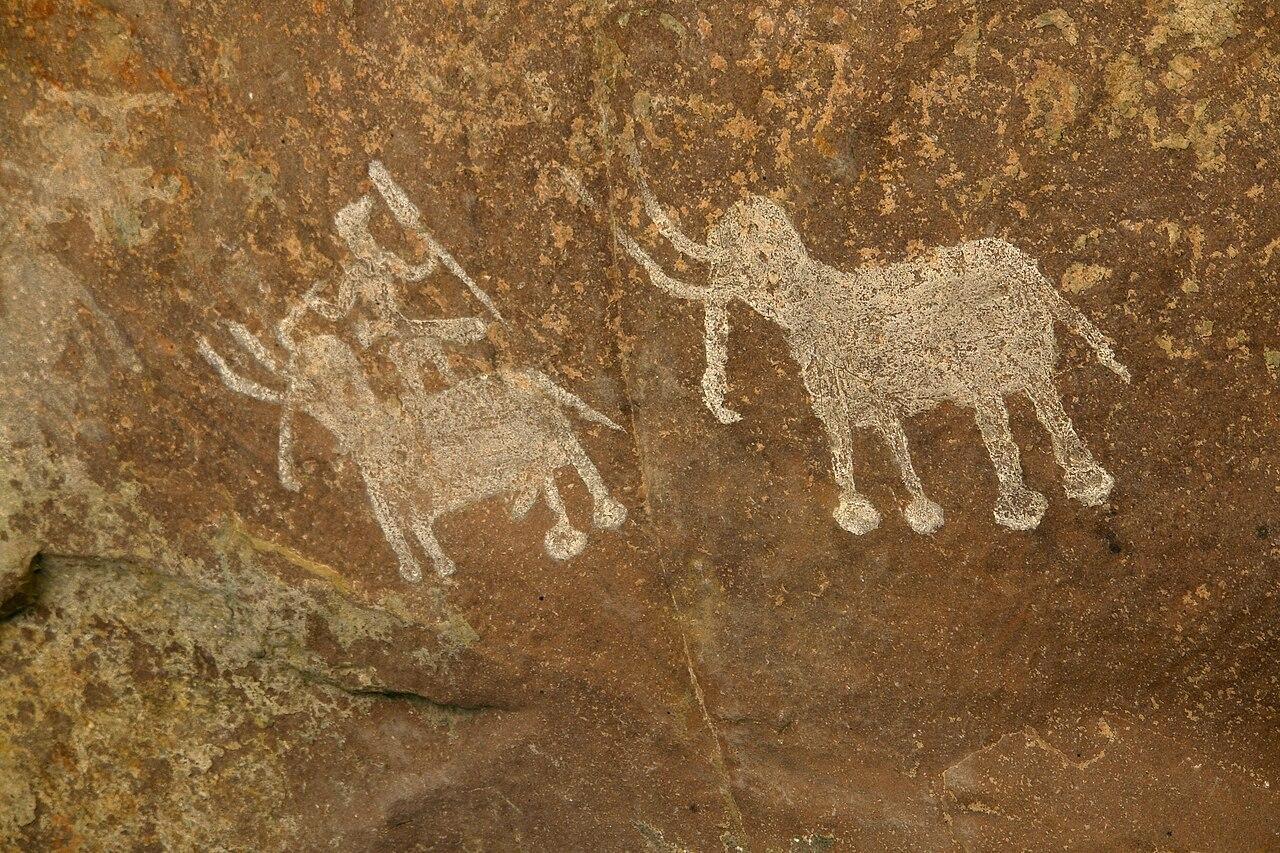
Bhimbetka
A dense cluster of sandstone rock shelters in the foothills of the Vindhyas, with stone-tool deposits reaching back to the Acheulian and paintings spanning from the Mesolithic into historical times.
Dhaba
A site in the Middle Son valley with a stone-tool sequence spanning about 80,000 to 65,000 years ago, across the Toba eruption.
Jwalapuram
Sites in the Jurreru valley where Middle Palaeolithic tools lie both below and above the ash of the Toba super-eruption (c. 74,000 years ago), suggesting people persisted through it.
Land link between India and Sri Lanka
The sea between India and Sri Lanka is shallow; Adam's Bridge is a chain of shoals only a few metres deep. While sea level stood lower in the last ice age, the two were one landmass. In the coastline model used on this atlas, the link is cut once the sea rises to between about 10 and 5 metres below today, which the sea-level curve places roughly 8,000 to 6,500 years ago.
Fa-Hien Lena
A large rainforest cave in south-western Sri Lanka with evidence of Homo sapiens from around 48,000 years ago, including specialised hunting of monkeys and squirrels.
Conclusions
What deep time tells us
- India's rocks record a continent's journey from Gondwana to island and then to collision with Asia: Jurassic sauropods, Cretaceous nesting grounds and the Deccan eruptions at the end of the dinosaur age are all well documented.
- The earliest stages of whale evolution are known largely from Eocene rocks of Pakistan and Jammu.
- Acheulian toolmakers were present by about 1.5–1.2 million years ago (Attirampakkam, Isampur). Older claims from Masol and Riwat remain debated.
- The Narmada skull cap is the only fossil cranium of an archaic (pre-modern) human from South Asia; its age and species are still uncertain.
- Stone-tool sequences at Jwalapuram and Dhaba suggest people lived through the Toba eruption, but who they were — and how they relate to later modern humans — is unresolved.
Sources & Further Reading
Sources & further reading
- journal articleJain, S. L., Kutty, T. S., Roy-Chowdhury, T. & Chatterjee, S. (1975). The sauropod dinosaur from the Lower Jurassic Kota Formation of India. Proceedings of the Royal Society of London B 188(1091): 221–228. doi:10.1098/rspb.1975.0014
- journal articleLydekker, R. (1877). Notices of new and other Vertebrata from Indian Tertiary and Secondary rocks. Records of the Geological Survey of India 10(1): 30–43.record unverified
- journal articleWilson, J. A., Sereno, P. C., Srivastava, S., Bhatt, D. K., Khosla, A. & Sahni, A. (2003). A new abelisaurid (Dinosauria, Theropoda) from the Lameta Formation (Cretaceous, Maastrichtian) of India. Contributions from the Museum of Paleontology, University of Michigan 31(1): 1–42.
- journal articleMohabey, D. M. (1984). The study of dinosaurian eggs from infratrappean limestone in Kheda District, Gujarat. Journal of the Geological Society of India 25(6): 329–337. doi:10.17491/jgsi/1984/250601
- journal articleDhiman, H., Verma, V., Singh, L. R., Miglani, V., Jha, D. K., Sanyal, P., Tandon, S. K. & Prasad, G. V. R. (2023). New Late Cretaceous titanosaur sauropod dinosaur egg clutches from lower Narmada valley, India: Palaeobiology and taphonomy. PLOS ONE 18(1): e0278242. doi:10.1371/journal.pone.0278242
- journal articleSchoene, B. et al. (2019). U-Pb constraints on pulsed eruption of the Deccan Traps across the end-Cretaceous mass extinction. Science 363(6429): 862–866. doi:10.1126/science.aau2422
- journal articleSprain, C. J. et al. (2019). The eruptive tempo of Deccan volcanism in relation to the Cretaceous-Paleogene boundary. Science 363(6429): 866–870. doi:10.1126/science.aav1446
- journal articleGingerich, P. D., Wells, N. A., Russell, D. E. & Shah, S. M. I. (1983). Origin of whales in epicontinental remnant seas: new evidence from the early Eocene of Pakistan. Science 220(4595): 403–406. doi:10.1126/science.220.4595.403
- journal articleThewissen, J. G. M., Cooper, L. N., Clementz, M. T., Bajpai, S. & Tiwari, B. N. (2007). Whales originated from aquatic artiodactyls in the Eocene epoch of India. Nature 450: 1190–1194. doi:10.1038/nature06343
- journal articlePilbeam, D. (1982). New hominoid skull material from the Miocene of Pakistan. Nature 295: 232–234. doi:10.1038/295232a0
- journal articleDambricourt Malassé, A. et al. (2016). Intentional cut marks on bovid from the Quranwala zone, 2.6 Ma, Siwalik Frontal Range, northwestern India. Comptes Rendus Palevol 15(3–4): 317–339. doi:10.1016/j.crpv.2015.09.019
- journal articleSoni, V. S. & Soni, A. S. (2017). On the Late Pliocene stone tools of the Quranwala Zone, north-west sub-Himalayas, India. Antiquity 91(357) (Project Gallery). doi:10.15184/aqy.2017.43
- journal articleDennell, R. W., Rendell, H. & Hailwood, E. (1988). Early tool-making in Asia: two-million-year-old artefacts in Pakistan. Antiquity 62(234): 98–106. doi:10.1017/S0003598X00073555
- journal articlePappu, S. et al. (2011). Early Pleistocene presence of Acheulian hominins in South India. Science 331(6024): 1596–1599. doi:10.1126/science.1200183
- journal articleAkhilesh, K. et al. (2018). Early Middle Palaeolithic culture in India around 385–172 ka reframes Out of Africa models. Nature 554: 97–101. doi:10.1038/nature25444
- journal articlePaddayya, K., Blackwell, B. A. B., Jhaldiyal, R., Petraglia, M. D. et al. (2002). Recent findings on the Acheulian of the Hunsgi and Baichbal valleys, Karnataka, with special reference to the Isampur excavation and its dating. Current Science 83(5): 641–647.
- journal articleSonakia, A. & Kennedy, K. A. R. (1985). Skull cap of an early man from the Narmada valley alluvium (Pleistocene) of central India. American Anthropologist 87(3): 612–616. doi:10.1525/aa.1985.87.3.02a00060
- journal articleKennedy, K. A. R., Sonakia, A., Chiment, J. & Verma, K. K. (1991). Is the Narmada hominid an Indian Homo erectus?. American Journal of Physical Anthropology 86(4): 475–496. doi:10.1002/ajpa.1330860404
- journal articlePatnaik, R., Chauhan, P. R., Rao, M. R., Blackwell, B. A. B., Skinner, A. R., Sahni, A., Chauhan, M. S. & Khan, H. S. (2009). New geochronological, paleoclimatological, and archaeological data from the Narmada Valley hominin locality, central India. Journal of Human Evolution 56(2): 114–133. doi:10.1016/j.jhevol.2008.08.023
- journal articleCameron, D., Patnaik, R. & Sahni, A. (2004). The phylogenetic significance of the Middle Pleistocene Narmada hominin cranium from central India. International Journal of Osteoarchaeology 14(6): 419–447. doi:10.1002/oa.725
- unescoUNESCO World Heritage Centre (2003). Rock Shelters of Bhimbetka (List no. 925). whc.unesco.org/en/list/925
- bookMathpal, Y. (1984). Prehistoric Rock Paintings of Bhimbetka, Central India. Abhinav Publications.
- bookConingham, R. & Young, R. (2015). The Archaeology of South Asia: From the Indus to Asoka, c. 6500 BCE–200 CE. Cambridge University Press.
- journal articleClarkson, C. et al. (2020). Human occupation of northern India spans the Toba super-eruption ~74,000 years ago. Nature Communications 11: 961. doi:10.1038/s41467-020-14668-4
- journal articlePetraglia, M. et al. (2007). Middle Paleolithic assemblages from the Indian subcontinent before and after the Toba super-eruption. Science 317(5834): 114–116. doi:10.1126/science.1141564
- journal articleSpratt, R. M. & Lisiecki, L. E. (2016). A Late Pleistocene sea level stack. Climate of the Past 12: 1079–1092. doi:10.5194/cp-12-1079-2016 www.ncei.noaa.gov/pub/data/paleo/contributions_by_author/spratt2016/spratt2016.txt
- institutionalNOAA National Centers for Environmental Information (2022). ETOPO 2022 15 Arc-Second Global Relief Model (60 arc-second version used). doi:10.25921/fd45-gt74 www.ncei.noaa.gov/products/etopo-global-relief-model
- journal articleWedage, O. et al. (2019). Specialized rainforest hunting by Homo sapiens ~45,000 years ago. Nature Communications 10: 739. doi:10.1038/s41467-019-08623-1
- bookDeraniyagala, S. U. (1992). The Prehistory of Sri Lanka: An Ecological Perspective. Department of Archaeological Survey, Colombo.