Languages, scripts & literature
A thousand-year silence, then stone.
Between the end of the Indus script and Ashoka's edicts lies more than a millennium with no securely dated writing. What came after — Brahmi and its descendants — now writes much of Asia.
Attestation timeline
Indus script
Short sequences of signs on seals, tablets and pottery from the Indus civilisation. Undeciphered.
What is known
EstablishedSeveral hundred distinct signs have been catalogued. Most inscriptions are very short — the average is around five signs — and no bilingual text has been found.
SourcesParpola 1994
What We Still Don't Know
Competing hypotheses
HypothesisUnresolved questions and competing interpretations
Hypothesis: the script writes an early Dravidian language (argued at length by Asko Parpola and Iravatham Mahadevan).
Hypothesis: it writes an Indo-Aryan or other language (proposed by several scholars; not widely accepted).
Hypothesis: it is a non-linguistic symbol system rather than full writing (Farmer, Sproat and Witzel 2004). Rao et al. (2009) responded with statistical evidence of language-like structure, a claim itself contested.
None of these is established. Claims of decipherment appear regularly; none has gained scholarly consensus.
Brahmi
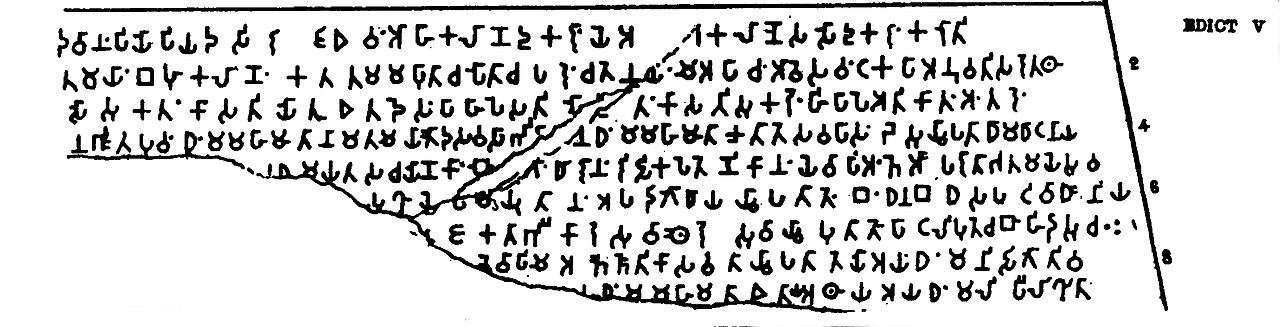
The script of most of Ashoka's edicts and the ancestor of nearly all later scripts of South and Southeast Asia, from Devanagari to Tamil and Thai.
Origins
DebatedWhether Brahmi was invented in the Mauryan period or developed earlier is debated. Many scholars see the influence of Aramaic or other Semitic scripts in its basic principle; some recent finds, including inscribed sherds from Sri Lanka and Tamil Nadu, have been argued to pre-date Ashoka.
SourcesSalomon 1998
Decipherment
EstablishedBrahmi was deciphered by James Prinsep in 1837.
SourcesSalomon 1998
Kharoshthi
A script derived from Aramaic, used in Gandhara and adjoining regions from the 3rd century BCE to around the 3rd–4th century CE.
Overview
Well supportedKharoshthi probably developed from Aramaic used in the Achaemenid administration of the northwest. It also appears on Gandharan Buddhist manuscripts, among the oldest surviving Buddhist texts.
SourcesSalomon 1998
Tamil-Brahmi
An adaptation of Brahmi to write Old Tamil, found in cave inscriptions and on pottery across Tamil Nadu and beyond.
Overview
EstablishedTamil-Brahmi adapted Brahmi to the sounds of Tamil, which lacks several consonant distinctions of Prakrit and has sounds Prakrit lacks. Mahadevan's corpus remains the standard reference.
SourcesMahadevan 2003
What We Still Don't Know
What we still don't know
DebatedUnresolved questions and competing interpretations
The earliest date of Tamil-Brahmi is debated. Radiocarbon dates from Keeladi and other sites have been used to argue for a start before the Mauryan period; others question the association of samples with inscribed sherds.
SourcesTamil Nadu State Department of Archaeology 2019; Mahadevan 2003
Prakrit
The Middle Indo-Aryan vernaculars in which Ashoka's edicts and most early inscriptions were written.
Overview
EstablishedUntil the 1st–2nd century CE, Prakrit rather than Sanskrit was the main language of inscriptions. Pali, the canonical language of Theravada Buddhism, is closely related.
SourcesSalomon 1998
Sanskrit
An Old Indo-Aryan language, the language of the Vedas in its earliest form, which became dominant in royal inscriptions from the Gupta period.
Oral before written
EstablishedVedic texts were composed and transmitted orally for many centuries. Sanskrit appears in inscriptions only from around the 1st century BCE, and becomes the dominant epigraphic language from the 4th century CE.
SourcesSalomon 1998
Sources & Further Reading
Sources & further reading
- bookParpola, A. (1994). Deciphering the Indus Script. Cambridge University Press.
- journal articleFarmer, S., Sproat, R. & Witzel, M. (2004). The Collapse of the Indus-Script Thesis: The Myth of a Literate Harappan Civilization. Electronic Journal of Vedic Studies 11(2): 19–57.
- journal articleRao, R. P. N. et al. (2009). Entropic evidence for linguistic structure in the Indus script. Science 324(5931): 1165. doi:10.1126/science.1170391
- bookSalomon, R. (1998). Indian Epigraphy: A Guide to the Study of Inscriptions in Sanskrit, Prakrit, and the Other Indo-Aryan Languages. Oxford University Press.
- inscription corpusHultzsch, E. (1925). Inscriptions of Asoka. Corpus Inscriptionum Indicarum, Vol. I (new edition). Clarendon Press.
- inscription corpusMahadevan, I. (2003). Early Tamil Epigraphy: From the Earliest Times to the Sixth Century A.D.. Harvard Oriental Series 62. Harvard University Press / Cre-A.
- excavation reportTamil Nadu State Department of Archaeology (2019). Keeladi: An Urban Settlement of Sangam Age on the Banks of River Vaigai. Government of Tamil Nadu.
- journal articleWitzel, M. (1995). Early Sanskritization: Origins and Development of the Kuru State. Electronic Journal of Vedic Studies 1(4).