Period 10 of 16
Regional Kingdoms and Empires
The imperial Cholas, Rashtrakutas, Palas, Pratiharas and later Vijayanagara: large regional states with maritime and continental ambitions.
In preparation
This period is framed but not yet fully populated. Indophile is being built in phases, starting with prehistory through the classical period. Entries below are those already in the archive.
Major developments
- 01Chola naval expeditions
- 02Brihadisvara temple at Thanjavur
- 03Vijayanagara empire
The Map Check
Where this period happened
Click a point to open its record. Boundaries at 1158 CE from Cliopatria (Seshat), CC BY 4.0.
Polities & cultures
Civilisations, kingdoms and republics
Imperial Cholas
A Tamil dynasty that from the 9th century built a powerful state in the Kaveri delta, with naval expeditions to Sri Lanka and Southeast Asia.
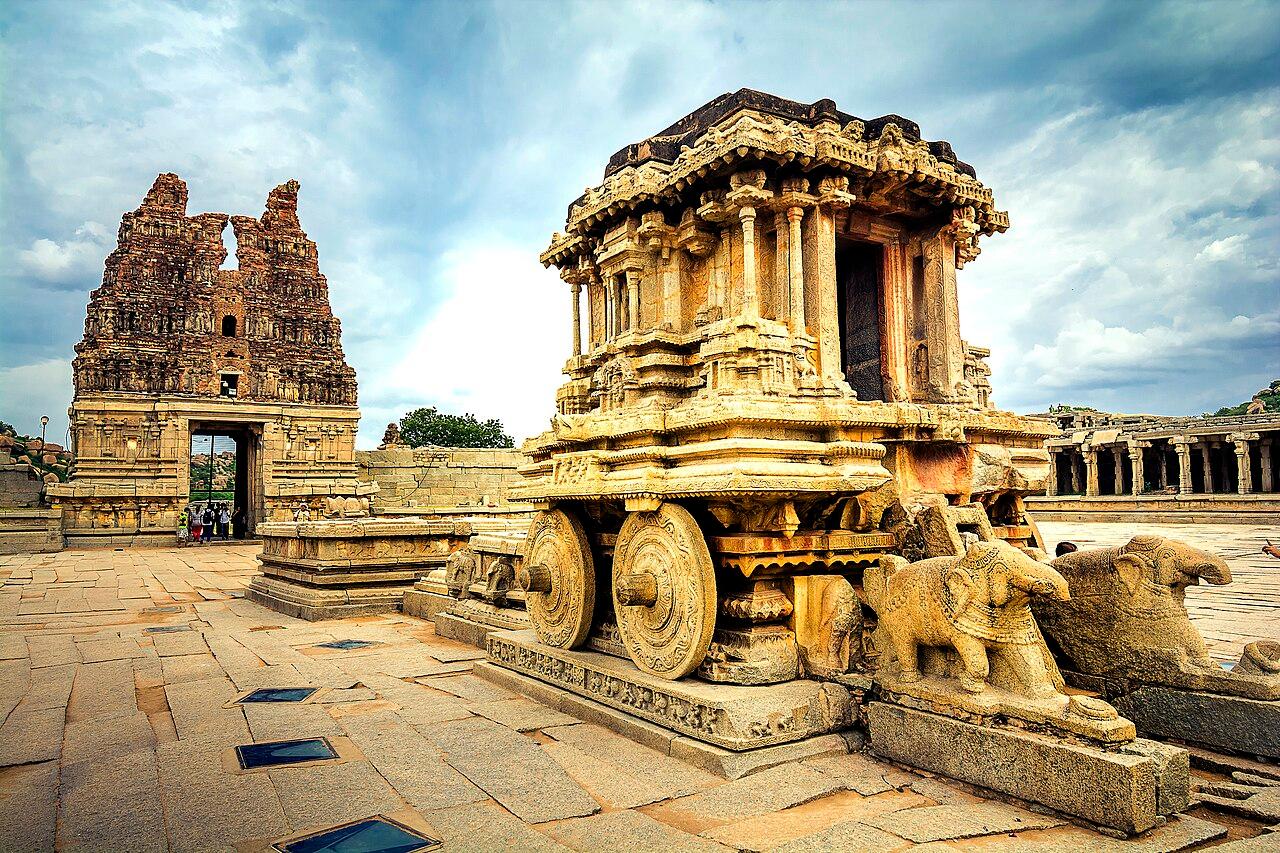
Vijayanagara Empire
A south Indian empire founded in 1336, with its capital at Hampi, that dominated the peninsula until its defeat in 1565.
Western Gangas of Talakad
A long-lived dynasty of southern Karnataka, frequently subordinate to larger neighbours; its minister Chavundaraya commissioned the Gommateshvara colossus at Shravanabelagola.
Pallavas
A dynasty of Kanchipuram whose rock-cut and structural temples at Mamallapuram and Kanchi are landmarks of early Dravidian architecture.
Chalukyas of Badami
A Deccan power whose Pulakeshin II checked Harsha on the Narmada; temples at Aihole, Badami and Pattadakal mix northern and southern styles.
Eastern Chalukyas of Vengi
A branch of the Badami Chalukyas that ruled Vengi for over four centuries, tied by marriage to the Cholas until the two lines merged under Kulottunga I.
Maitrakas of Valabhi
A Gujarat dynasty whose capital Valabhi was a noted centre of learning, recorded by Xuanzang.
Kamarupa
The early historic kingdom of Assam under the Varman, Mlechchha and Pala dynasties of Kamarupa, recorded in copper-plate grants and by Xuanzang.
Licchavis of Nepal
Rulers of the Kathmandu valley whose Sanskrit inscriptions begin with Manadeva's pillar at Changu Narayan (464 CE).
Anuradhapura Kingdom
The first great Sri Lankan kingdom, centred on Anuradhapura, whose history is recorded in the Pali chronicles (Dipavamsa, Mahavamsa) and in Brahmi inscriptions. Its early dates follow the chronicles' chronology.
Karkota dynasty of Kashmir
Kashmiri dynasty of Lalitaditya Muktapida, builder of the Martand sun temple and Parihasapura, known chiefly from Kalhana's Rajatarangini.
Utpala and Lohara dynasties of Kashmir
Successive Kashmiri dynasties from Avantivarman, founder of Avantipura, to the establishment of the Shah Mir sultanate.
Pala Empire
A Buddhist-patronising dynasty of eastern India, patrons of Nalanda, Vikramashila and Somapura, which at its height contested Kannauj with the Pratiharas and Rashtrakutas.
Gurjara-Pratiharas
A dynasty that ruled from Kannauj in the 9th–10th centuries and was one of the three powers in the 'tripartite struggle' for the Ganga valley.
Rashtrakutas of Manyakheta
A Deccan empire that displaced the Badami Chalukyas; Krishna I is credited with the monolithic Kailasa temple at Ellora.
Western Chalukyas of Kalyani
A revived Chalukya line that fought the Cholas for the Deccan; its feudatories included the Hoysalas, Kakatiyas and Yadavas, who all later became independent.
Chera Perumals of Mahodayapuram
Rulers of Kerala known from copper plates such as the Tharisapalli grant (849 CE) from Kollam.
Hindu Shahis
Rulers of Kabul and Gandhara, later of the Punjab from Udabhandapura, defeated by the Ghaznavids in the early 11th century.
Ghaznavids (in the Punjab)
A Turkic dynasty of Ghazni whose raids under Mahmud reached Somnath; after losing Ghazni, its last rulers held Lahore until 1186.
Eastern Gangas
Rulers of Kalinga whose Anantavarman Chodaganga began the Jagannatha temple at Puri; Narasimhadeva I built the Konark sun temple in the 13th century.
Chandelas of Jejakabhukti
Builders of the temples of Khajuraho, ruling from strong forts at Kalinjar and Mahoba.
Paramaras of Malwa
A Malwa dynasty whose best-known ruler, Bhoja (r. c. 1010–1055), was famed as a patron and author.
Chahamanas of Shakambhari
A Rajasthan dynasty whose last major ruler, Prithviraja III, was defeated at the second battle of Tarain in 1192.
Chaulukyas of Gujarat
Rulers of Gujarat from Anahilapataka, patrons of the Modhera sun temple and the Rani-ki-Vav stepwell; Mahmud of Ghazni sacked Somnath in their time.
Kalachuris of Tripuri
A dynasty of central India ruling near Jabalpur; the Chausath Yogini temple at Bheraghat dates to their time.
Gahadavalas
Rulers of Kannauj and Varanasi in the 12th century, ended by the Ghurid conquest.
Senas of Bengal
Successors of the Palas in Bengal, displaced from western Bengal by Bakhtiyar Khalji around 1204 but surviving in the east for a few decades.
Polonnaruwa Kingdom
After Vijayabahu I expelled the Cholas, Polonnaruwa became Sri Lanka's capital; Parakramabahu I (r. 1153–1186) built its great reservoirs and monuments.
Hoysalas
A Karnataka dynasty, at first feudatories of the Kalyani Chalukyas, whose star-shaped temples at Belur, Halebidu and Somanathapura are UNESCO-listed.
Kakatiyas
An Andhra dynasty ruling from Orugallu (Warangal); Rudramadevi was one of the few women to rule in her own name. Their kingdom fell to the Delhi Sultanate in 1323.
Recherla Nayakas (Kakatiya period)
A warrior lineage serving the Kakatiyas as generals and subordinate rulers. Recherla Rudra built the Ramappa (Rudreshwara) temple at Palampet in 1213 CE.
Padmanayakas (Recherla Velamas) of Rachakonda
Nayaka rulers who emerged after the fall of the Kakatiyas, governing from the hill forts of Rachakonda and Devarakonda between the Bahmani and Vijayanagara powers.
Musunuri Nayakas
Nayaka chiefs who drove the Delhi Sultanate out of Warangal after 1323 and held it until the Bahmanis and Padmanayakas overcame them.
Reddi kingdom
A post-Kakatiya kingdom ruling from Addanki and Kondavidu, later Rajahmundry, eventually absorbed by the Gajapatis.
Yadavas (Seunas) of Devagiri
A Deccan dynasty ruling from the fortress of Devagiri, which became the Delhi Sultanate's Daulatabad.
Later Pandyas
A Pandya revival that, under Jatavarman Sundara Pandya (r. 1251–1268), became the leading power of the south; Marco Polo described their port Kayal.
Bahmani Sultanate
A Deccan sultanate founded in revolt against the Tughluqs, ruling from Gulbarga and then Bidar; it fragmented into the five Deccan sultanates.
Gajapatis of Odisha
A dynasty founded by Kapilendra Deva that pushed down the eastern coast as far as the Krishna and beyond for a time.
Bengal Sultanate
An independent sultanate whose brick mosques at Pandua, Gaur and Bagerhat define a distinctive Bengali architecture.
Gujarat Sultanate
A rich maritime sultanate that founded Ahmedabad in 1411 and was annexed by Akbar in 1573.
Malwa Sultanate
A central Indian sultanate ruling from the plateau fortress of Mandu.
Jaunpur Sultanate
The Sharqi sultanate of Jaunpur, known for its monumental Atala mosque, ended by the Lodis.
Kashmir Sultanate
The Shah Mir and Chak dynasties of Kashmir, until annexation by Akbar.
Mewar (Sisodia Ranas)
A Rajput kingdom ruled from Chittor and later Udaipur; Rana Kumbha built Kumbhalgarh, and Mewar resisted Mughal overlordship until 1615.
Marwar (Rathores of Jodhpur)
A Rajput kingdom whose capital Jodhpur was founded by Rao Jodha in 1459.
Ahom Kingdom
Founded by Sukaphaa in 1228, the Ahom state ruled the Brahmaputra valley for six centuries, resisted Mughal expansion (Saraighat, 1671) and kept court chronicles called buranjis.
Jaffna Kingdom
A Tamil kingdom of the Jaffna peninsula under the Aryacakravarti rulers, annexed by the Portuguese in 1619.
Dambadeniya to Gampola kingdoms
After the fall of Polonnaruwa the Sinhala capital moved south-west in stages: Dambadeniya, Yapahuwa, Kurunegala and Gampola.
Kingdom of Kotte
The lowland Sinhala kingdom that met the Portuguese in 1505 and was absorbed by them in 1597.
Kingdom of Kandy
The highland kingdom that outlasted Portuguese and Dutch coastal rule and fell to the British in 1815.
Ahmadnagar Sultanate (Nizam Shahis)
One of the five Deccan successor states of the Bahmanis, finally absorbed by the Mughals.
Bijapur Sultanate (Adil Shahis)
A Deccan sultanate whose Gol Gumbaz is among the largest domes of the pre-modern world; annexed by Aurangzeb in 1686.
Golconda Sultanate (Qutb Shahis)
A diamond-rich Deccan sultanate that founded Hyderabad in 1591; annexed by Aurangzeb in 1687.
Bidar Sultanate (Barid Shahis)
The smallest Bahmani successor, holding the old capital Bidar until Bijapur absorbed it.
Berar Sultanate (Imad Shahis)
A Bahmani successor in Berar, absorbed by Ahmadnagar in 1574.
Zamorins of Calicut
Rulers of the trading port of Calicut, where Vasco da Gama landed in 1498.
Keladi Nayakas (Ikkeri)
Former Vijayanagara subordinates who ruled the pepper-producing hills and coast of Karnataka until Hyder Ali took Bednur.
Nayakas of Madurai
Vijayanagara governors who became effectively independent; Tirumala Nayaka rebuilt much of the Meenakshi temple complex.
Nayakas of Thanjavur
A Vijayanagara successor state in the Kaveri delta, followed by a Maratha dynasty at Thanjavur.
Sur Empire
The Afghan empire of Sher Shah Sur, who drove Humayun out of India in 1540; his administrative and revenue reforms were continued by the Mughals.
Estado da Índia (Portuguese enclaves)
Portuguese holdings centred on Goa, taken from Bijapur in 1510, with Daman and Diu on the Gujarat coast.
Bhauma-Karas of Odisha
A dynasty of Odisha known from copper plates, patrons of both Buddhist and Brahmanical institutions.
Somavamshis of Odisha
Rulers of Odisha associated with the early temples of Bhubaneswar.
Arab Sindh (Umayyad–Abbasid province)
After Muhammad bin Qasim's conquest in 712, Sindh was a province of the caliphate, later ruled by local emirates at Mansura and Multan until the Ghaznavid period.
Shilaharas
Branches of the Shilahara family ruled the northern and southern Konkan and Kolhapur, often as feudatories of larger Deccan powers.
Kadambas of Goa
A coastal dynasty ruling from Chandor and then Gopakapattana, a busy port.
Ghurids (in India)
Muhammad of Ghur's campaigns took Lahore (1186), defeated Prithviraja at Tarain (1192) and reached Bihar and Bengal; his generals founded the Delhi Sultanate.
Kampili kingdom
A short-lived kingdom on the Tungabhadra destroyed by Muhammad bin Tughluq; its former officers are traditionally linked to the founding of Vijayanagara.
Madurai Sultanate
A sultanate founded by the Tughluq governor Jalaluddin Ahsan Khan, described by Ibn Battuta, and ended by Vijayanagara's Kumara Kampana.
Sambuvarayars of Padaividu
A chiefly lineage of the Palar valley that asserted independence after the Chola decline and was subdued by Vijayanagara's Kumara Kampana.
Venad
The southern Kerala kingdom centred on Kollam that emerged after the Chera Perumals and was reorganised as Travancore by Marthanda Varma.
Kingdom of Cochin (Perumpadappu)
A Kerala kingdom that allied with the Portuguese against the Zamorin and later came under Dutch and British influence.
Kolathunad
The northern Malabar kingdom of the Kolathiris, centred near Kannur.
Vanni chieftaincies
Semi-independent chiefs (vanniyar) of the dry zone between the Jaffna kingdom and the Sinhala kingdoms, finally subdued by the British.
Nayakas of Gingee
Vijayanagara Nayaka governors of the Gingee fortress, later taken by Bijapur and then the Marathas.
Samma Sultanate of Sindh
A Sindhi dynasty ruling from Thatta; its royal necropolis on the Makli hills is a World Heritage site.
Langah Sultanate of Multan
An independent sultanate of Multan between the Delhi Sultanate's decline and the Mughal conquest.
Khandesh (Farooqi Sultanate)
A sultanate of the Tapti valley whose fortress of Asirgarh fell to Akbar in 1601.
Garha–Mandla (Gond kingdom)
A Gond kingdom of the upper Narmada; its queen Rani Durgavati died resisting the Mughals in 1564.
Tripura (Manikya dynasty)
A kingdom of the Manikya rulers, chronicled in the Rajmala, that at times held much of eastern Bengal.
Manipur (Meitei kingdom)
The Meitei kingdom of the Imphal valley, recorded in the royal chronicle Cheitharol Kumbaba; it became a British protectorate after 1891.
Mrauk U (Arakan)
A coastal kingdom that held Chittagong for long periods and had close ties with the Bengal Sultanate.
Garhwal kingdom
A Himalayan kingdom of the upper Ganga, ruled from Srinagar (Garhwal) until the Gorkha conquest.
Kumaon (Chand dynasty)
The Chand kingdom of Kumaon, later ruled from Almora, conquered by the Gorkhas in 1790.
Bundelas of Orchha
A Rajput dynasty whose capital Orchha preserves palaces and temples of the 16th–17th centuries.
Amber / Jaipur (Kachwahas)
A Rajput kingdom closely allied to the Mughals; Jai Singh II founded Jaipur in 1727 and built its observatories.
Bikaner
A Rathore kingdom of the Thar desert founded by Rao Bika in 1488.
Jaisalmer
A Bhati Rajput kingdom on desert caravan routes, ruled from the hill fort founded in 1156.
Kanauj under Yashovarman
Yashovarman ruled Kanauj in the second quarter of the 8th century; the Prakrit poem Gaudavaho celebrates his campaigns. The Rajatarangini says he was defeated by Lalitaditya of Kashmir. Little is known of his successors.
Turk Shahis
Rulers of Kabul and Gandhara who held the passes against the early Arab advance for some two centuries. They were supplanted in the 9th century by the line known as the Hindu Shahis. Their dates come from coins and Arabic and Chinese notices and are approximate.
Pandyas of Madurai (early medieval)
The Pandya line revived under Kadungon around the end of the 6th century and contested the far south with the Pallavas and Cheras. Parantaka I Chola took Madurai in the early 10th century, and Pandya country stayed under Chola control until the 13th-century revival.
Chandras of eastern Bengal
Buddhist dynasty of south-eastern Bengal, known from copper-plate grants issued from Vikramapura. The Chola inscription describing Rajendra I's northern expedition names Govindachandra among the rulers it defeated.
Malla kingdoms of the Kathmandu valley
The Mallas ruled the Nepal valley from about 1200. After the late 15th century the valley was divided among three courts at Kathmandu, Patan and Bhaktapur, whose rivalry produced the palace squares that survive today. Prithvi Narayan Shah of Gorkha conquered all three in 1768–69.
Timurid Empire
Founded by Timur from Samarkand. His invasion of 1398 sacked Delhi and broke the Tughluq sultanate. His descendants ruled from Samarkand and Herat until the Uzbeks took both; one of them, Babur, went on from Kabul to found the Mughal empire in 1526.
Maldives Sultanate
The Maldives converted to Islam, by tradition in 1153, and remained a sultanate until 1968; Ibn Battuta served there as a judge.
From the trenches
Archaeological sites
Hampi
The capital of the Vijayanagara Empire, set among granite boulders on the Tungabhadra; sacked after the battle of 1565.
Thanjavur
Capital of the imperial Cholas. The Brihadisvara temple, built by Rajaraja I and completed around 1010 CE, is covered with inscriptions recording its endowments.
Battle of Talikota (Rakshasa-Tangadi)
January 1565 defeat of Vijayanagara by an alliance of Deccan sultanates.
Ellora
Thirty-four rock-cut monasteries and temples — Buddhist, Hindu and Jain — cut side by side into a basalt escarpment between about 600 and 1000 CE, including the monolithic Kailasa temple.
Polonnaruwa
Sri Lanka's capital in the 11th–13th centuries, with Chola-period Hindu shrines, Parakramabahu I's palace and the Gal Vihara rock-cut Buddhas.
Chronology
Events
Brihadisvara temple completedEventc. 1010 CE(Secure date)Chola naval raid on SrivijayaEventc. 1025 CE(Approximate)Mahmud of Ghazni sacks SomnathEventJanuary 1026 CE(Secure date)Second battle of TarainEvent1192 CE(Secure date)Ramappa temple builtEvent1213 CE(Secure date)Foundation of VijayanagaraEventc. 1336 CE(Conventional date)Vasco da Gama reaches CalicutEventMay 1498(Secure date)Portuguese take GoaEventNovember 1510(Secure date)Battle of TalikotaEvent1565 CE(Secure date)People
Rajaraja IPersonr. 985 – 1014 CE(Secure date)Bhaskara IIPersonb. 1114 CE; Siddhantashiromani 1150 CE(Approximate)RamanujaPersontraditional 1017 – 1137 CE(Debated)BasavaPerson12th century CE(Approximate)Al-BiruniPerson973 – after 1050 CE(Approximate)Rajendra IPersonr. 1014 – 1044 CE(Secure date)RudramadeviPersonr. c. 1262 – 1289 CE(Conventional date)KrishnadevarayaPersonr. 1509 – 1529 CE(Secure date)Conclusions
What the evidence supports
- Large regional states — Cholas, Rashtrakutas, Palas, later Vijayanagara — built monumental temples and, in the Cholas' case, sent naval expeditions overseas.
Still open
What we still don't know
- The degree of central control in states often described as 'segmentary'.
Connected to Regional Kingdoms and Empires
Continue exploring
Imperial Cholas
A Tamil dynasty that from the 9th century built a powerful state in the Kaveri delta, with naval expeditions to Sri Lanka and Southeast Asia.
Vijayanagara Empire
A south Indian empire founded in 1336, with its capital at Hampi, that dominated the peninsula until its defeat in 1565.
Western Gangas of Talakad
A long-lived dynasty of southern Karnataka, frequently subordinate to larger neighbours; its minister Chavundaraya commissioned the Gommateshvara colossus at Shravanabelagola.
Pallavas
A dynasty of Kanchipuram whose rock-cut and structural temples at Mamallapuram and Kanchi are landmarks of early Dravidian architecture.
Chalukyas of Badami
A Deccan power whose Pulakeshin II checked Harsha on the Narmada; temples at Aihole, Badami and Pattadakal mix northern and southern styles.
Eastern Chalukyas of Vengi
A branch of the Badami Chalukyas that ruled Vengi for over four centuries, tied by marriage to the Cholas until the two lines merged under Kulottunga I.
Maitrakas of Valabhi
A Gujarat dynasty whose capital Valabhi was a noted centre of learning, recorded by Xuanzang.
Kamarupa
The early historic kingdom of Assam under the Varman, Mlechchha and Pala dynasties of Kamarupa, recorded in copper-plate grants and by Xuanzang.
Sources & Further Reading
Sources & further reading
- bookSingh, U. (2008). A History of Ancient and Early Medieval India: From the Stone Age to the 12th Century. Pearson Longman.