Archaeological site
Ellora
Thirty-four rock-cut monasteries and temples — Buddhist, Hindu and Jain — cut side by side into a basalt escarpment between about 600 and 1000 CE, including the monolithic Kailasa temple.
The Map Check
Location and neighbouring sites
Important findings
- Buddhist caves 1–12, including the multi-storeyed monasteries 11 and 12
- Hindu caves 13–29, including Cave 16, the Kailasa temple, carved downward from the rock
- Jain caves 30–34
The Historical Record
Who made Kailasa?
Well supportedInscriptions, texts, coins and other primary sources
The Kailasa temple is generally attributed to the Rashtrakuta king Krishna I (r. c. 756–773), on the basis of a later copper-plate description of a remarkable temple at Elapura. Some scholars argue its excavation spanned several reigns.
The three traditions at Ellora were not strictly sequential; Buddhist, Hindu and Jain patrons worked at the same escarpment, and the site is often cited as evidence of coexistence under shared patronage.
Connected to Ellora
Connected to this site
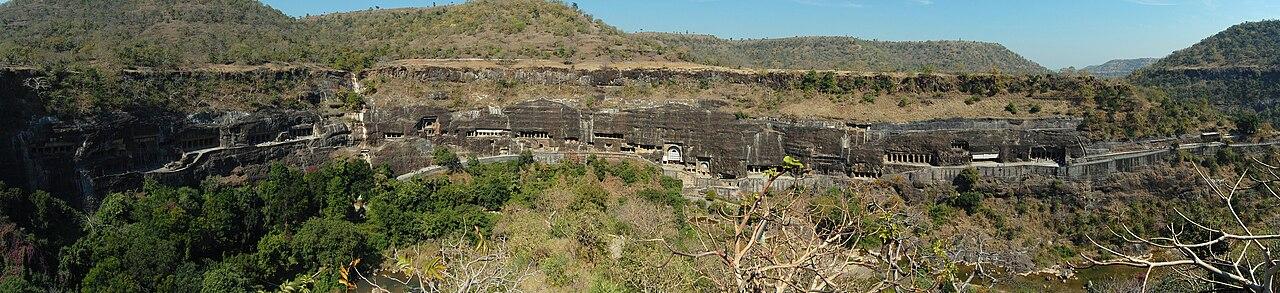
Ajanta
About thirty rock-cut Buddhist monasteries and shrines in a horseshoe gorge, made in two phases — around the 2nd–1st centuries BCE and in the later 5th century CE — with the finest surviving early Indian wall paintings.
Rashtrakutas of Manyakheta
A Deccan empire that displaced the Badami Chalukyas; Krishna I is credited with the monolithic Kailasa temple at Ellora.
Chalukyas of Badami
A Deccan power whose Pulakeshin II checked Harsha on the Narmada; temples at Aihole, Badami and Pattadakal mix northern and southern styles.
Kailasa temple cut at Ellora
The monolithic Kailasa temple (Ellora Cave 16) is excavated, generally attributed to the Rashtrakuta Krishna I.
Carved from the Mountain: Ajanta and Ellora
Buddhist, Hindu and Jain sanctuaries cut into the Deccan basalt.
Sources & Further Reading
Sources & further reading
- unescoUNESCO World Heritage Centre (1983). Ellora Caves (List no. 243). whc.unesco.org/en/list/243
- bookSastri, K. A. Nilakanta (1955). A History of South India from Prehistoric Times to the Fall of Vijayanagar. Oxford University Press.