Archaeological site
Ajanta
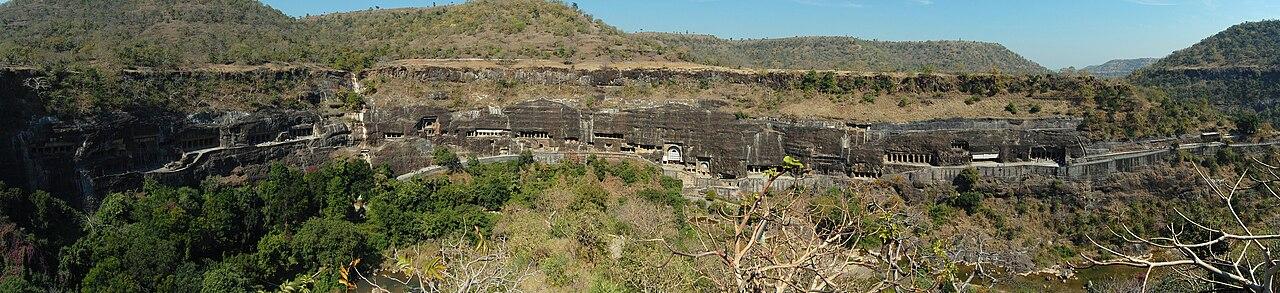
About thirty rock-cut Buddhist monasteries and shrines in a horseshoe gorge, made in two phases — around the 2nd–1st centuries BCE and in the later 5th century CE — with the finest surviving early Indian wall paintings.
The Map Check
Location and neighbouring sites
Important findings
- Early phase: chaitya halls 9 and 10 and viharas 12, 13 and 15A
- Later phase: richly painted viharas such as Caves 1, 2, 16 and 17, and chaitya halls 19 and 26
- Inscription of Varahadeva, minister of the Vakataka king Harishena, in Cave 16
- Wall paintings of Jataka stories and the life of the Buddha
From the Trenches
Two phases, three centuries apart
Well supportedWhat does the archaeological evidence reveal?
The earliest caves were cut in the last centuries BCE, in the period of Satavahana power in the Deccan. After a long gap, work resumed on a large scale in the 5th century CE, when the region was under the Vakatakas; most of the famous paintings belong to this second phase.
What We Still Don't Know
How long did the second phase last?
DebatedUnresolved questions and competing interpretations
Walter Spink argued for a 'short chronology' in which nearly all the later caves were made within a few decades of Harishena's reign (c. 460–480 CE), ending abruptly. Other scholars favour a longer span into the 6th century. The debate rests on inscriptions, unfinished work and stylistic change.
SourcesSpink 2005
Connected to Ajanta
Connected to this site
Ellora
Thirty-four rock-cut monasteries and temples — Buddhist, Hindu and Jain — cut side by side into a basalt escarpment between about 600 and 1000 CE, including the monolithic Kailasa temple.
Vakataka
A Deccan dynasty allied by marriage to the Guptas; a Vakataka minister's inscription is in Ajanta Cave 16, and the later Ajanta caves are usually dated to the reign of Harishena.
Satavahana Dynasty
A Deccan dynasty whose inscriptions, coins and patronage of Buddhist sites mark the political consolidation of the peninsula between the Narmada and the Krishna.
Carved from the Mountain: Ajanta and Ellora
Buddhist, Hindu and Jain sanctuaries cut into the Deccan basalt.
Sources & Further Reading
Sources & further reading
- unescoUNESCO World Heritage Centre (1983). Ajanta Caves (List no. 242). whc.unesco.org/en/list/242
- bookSingh, U. (2008). A History of Ancient and Early Medieval India: From the Stone Age to the 12th Century. Pearson Longman.
- bookSpink, W. M. (2005). Ajanta: History and Development, Volume 1 — The End of the Golden Age. Brill.