Curated collection · 6 entries
Carved from the Mountain: Ajanta and Ellora
Rock-cut architecture is subtractive: nothing is built, everything is carved away. Ajanta and Ellora show how the form developed over a thousand years and three religious traditions.
Curated by Indophile Editorial
- 01Sitec. 2nd century BCE – c. 480 CE(Approximate)
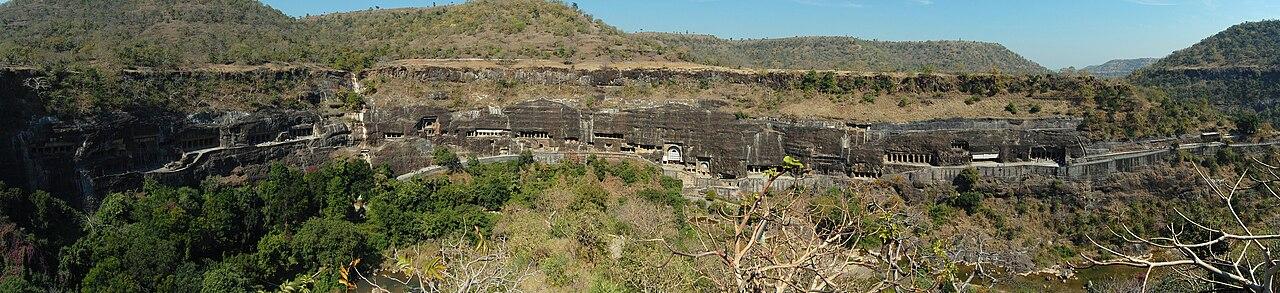
Ajanta
Two phases, three centuries apart.
About thirty rock-cut Buddhist monasteries and shrines in a horseshoe gorge, made in two phases — around the 2nd–1st centuries BCE and in the later 5th century CE — with the finest surviving early Indian wall paintings.
- 02Sitec. 600 – 1000 CE(Approximate)
Ellora
Thirty-four caves, three traditions.
Thirty-four rock-cut monasteries and temples — Buddhist, Hindu and Jain — cut side by side into a basalt escarpment between about 600 and 1000 CE, including the monolithic Kailasa temple.
- 03Eventc. 756 – 773 CE(Conventional date)
Kailasa temple cut at Ellora
A temple carved from the top down.
The monolithic Kailasa temple (Ellora Cave 16) is excavated, generally attributed to the Rashtrakuta Krishna I.
- 04Polityc. 250 – 500 CE(Approximate)
Vakataka
Patrons of later Ajanta.
A Deccan dynasty allied by marriage to the Guptas; a Vakataka minister's inscription is in Ajanta Cave 16, and the later Ajanta caves are usually dated to the reign of Harishena.
- 05Polity753 – 982 CE(Conventional date)
Rashtrakutas of Manyakheta
Patrons of Kailasa.
A Deccan empire that displaced the Badami Chalukyas; Krishna I is credited with the monolithic Kailasa temple at Ellora.
- 06SiteInscription dated year 82 of the Gupta era (401/402 CE)(Secure date)
Udayagiri Caves (Vidisha)
Gupta-period rock-cut shrines.
Rock-cut shrines near Vidisha with a monumental Varaha panel and an inscription dated in the reign of Chandragupta II.
The Map Check
Places in this collection
Sources & Further Reading
Sources & further reading
- unescoUNESCO World Heritage Centre (1983). Ajanta Caves (List no. 242). whc.unesco.org/en/list/242
- bookSingh, U. (2008). A History of Ancient and Early Medieval India: From the Stone Age to the 12th Century. Pearson Longman.
- bookSpink, W. M. (2005). Ajanta: History and Development, Volume 1 — The End of the Golden Age. Brill.
- unescoUNESCO World Heritage Centre (1983). Ellora Caves (List no. 243). whc.unesco.org/en/list/243
- bookSastri, K. A. Nilakanta (1955). A History of South India from Prehistoric Times to the Fall of Vijayanagar. Oxford University Press.
- inscription corpusFleet, J. F. (1888). Inscriptions of the Early Gupta Kings and their Successors. Corpus Inscriptionum Indicarum, Vol. III. Government of India.