Archaeological culture
Painted Grey Ware Culture
Also: PGW
An Iron Age archaeological culture of the Ganga–Yamuna plain, named after its fine grey pottery with black painted designs.
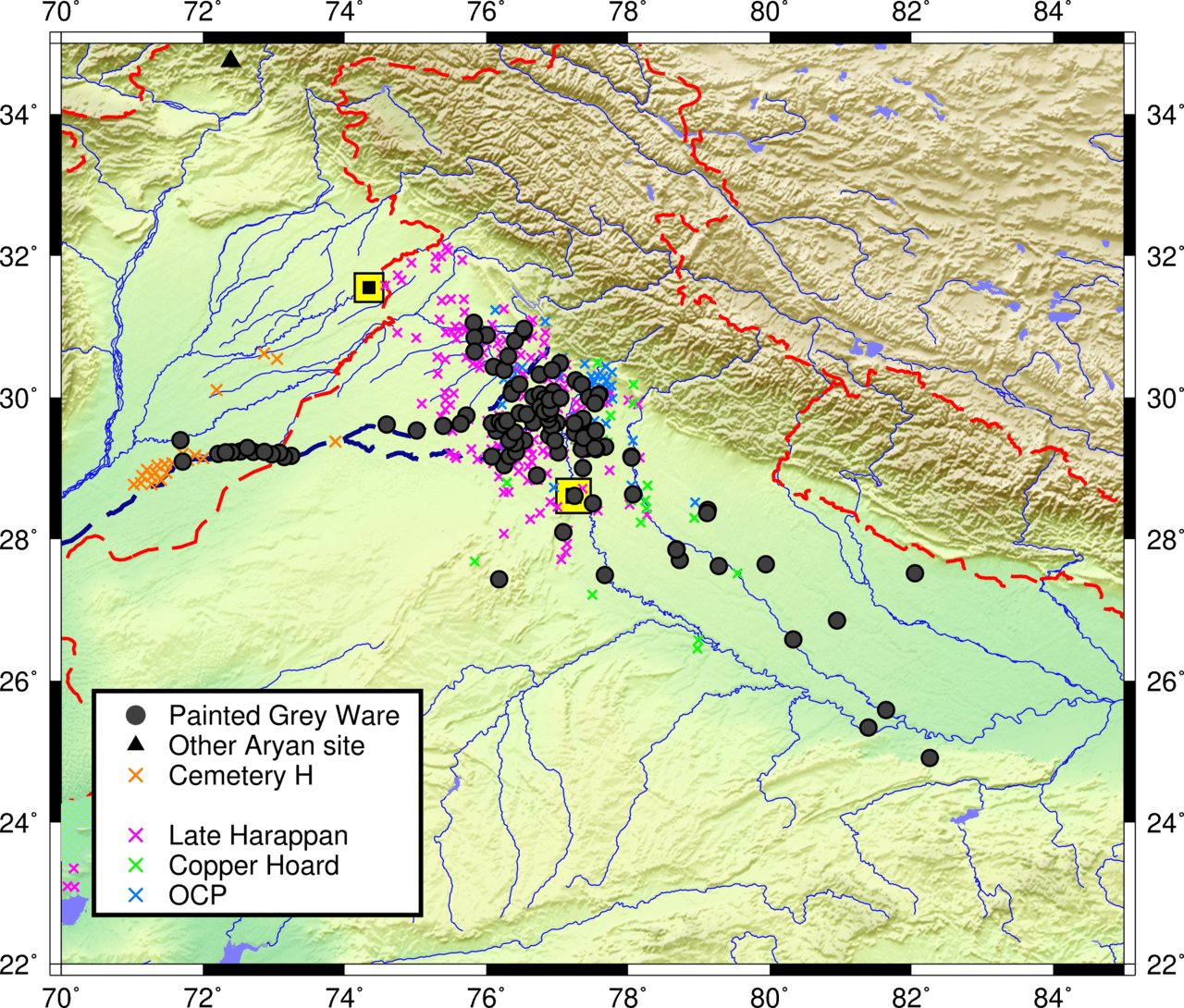
The Map Check
Geographic extent
No sourced boundary for this polity is available yet, so none is drawn. Points show the capitals, inscriptions and monuments that locate it.
Places that locate this polity
| Place | Role | Counted |
|---|---|---|
| Atranjikhera | site | whole period |
| Hastinapura | site | whole period |
| Ahichchhatra | site | whole period |
| Bhagwanpura | site | whole period |
| Jakhera | site | whole period |
Overview
DebatedPGW sites are typically small agricultural settlements. Iron tools appear in many PGW levels. The culture is often associated with the later Vedic Kuru–Panchala region, but this correlation is interpretive.
SourcesSingh 2008; Erdosy 1995
Connected to Painted Grey Ware Culture
Sites, evidence and research
Atranjikhera
A multi-period mound in the upper Ganga plain whose Painted Grey Ware levels yielded early iron objects and were central to debates on the beginnings of iron in north India.
Hastinapura
A mound in the upper Ganga valley with Painted Grey Ware levels, excavated by B. B. Lal in 1950–52 and associated in tradition with the Kurus.
Ahichchhatra
Capital of northern Panchala, with fortifications and a long early historic sequence.
Kuru
A polity of the later Vedic period in the upper Ganga–Yamuna region, which later Vedic texts associate with the codification of ritual and early forms of kingship.
Panchala
A janapada east of the Kurus in the Ganga–Yamuna doab, later divided into northern and southern Panchala.
Sinauli (Sanauli)
A cemetery near Delhi where excavations from 2005 and 2018 found burials with copper objects, a wooden coffin decorated with copper, and the remains of solid-wheeled vehicles. Their interpretation is strongly debated.
Iron in the Ganga plain
Iron objects appear in Painted Grey Ware levels at sites such as Atranjikhera.
The Indo-Aryan migration
The model that Indo-Aryan languages entered South Asia from Central Asia in the 2nd millennium BCE, carried by people with steppe-related ancestry who mixed with existing populations — not an 'invasion' or a single event.
Sources & Further Reading
Sources & further reading
- excavation reportGaur, R. C. (1983). Excavations at Atranjikhera: Early Civilization of the Upper Ganga Basin. Motilal Banarsidass.
- bookSingh, U. (2008). A History of Ancient and Early Medieval India: From the Stone Age to the 12th Century. Pearson Longman.
- bookErdosy, G. (ed.) (1995). The Indo-Aryans of Ancient South Asia: Language, Material Culture and Ethnicity. Walter de Gruyter.