Curated collection · 9 entries
Peopling the Subcontinent: Migrations Old and New
South Asian populations were formed by many movements over tens of thousands of years. This collection sets out the evidence for each, with its limits.
Curated by Indophile Editorial
- 01Sitec. 48,000 years ago onward(Approximate)
Fa-Hien Lena
Early modern humans in the far south.
A large rainforest cave in south-western Sri Lanka with evidence of Homo sapiens from around 48,000 years ago, including specialised hunting of monkeys and squirrels.
- 02SiteEarly Holocene (c. 10th–8th millennium BCE; dates debated)(Debated)
Sarai Nahar Rai
Ganga plain foragers — and what their DNA can't yet tell us.
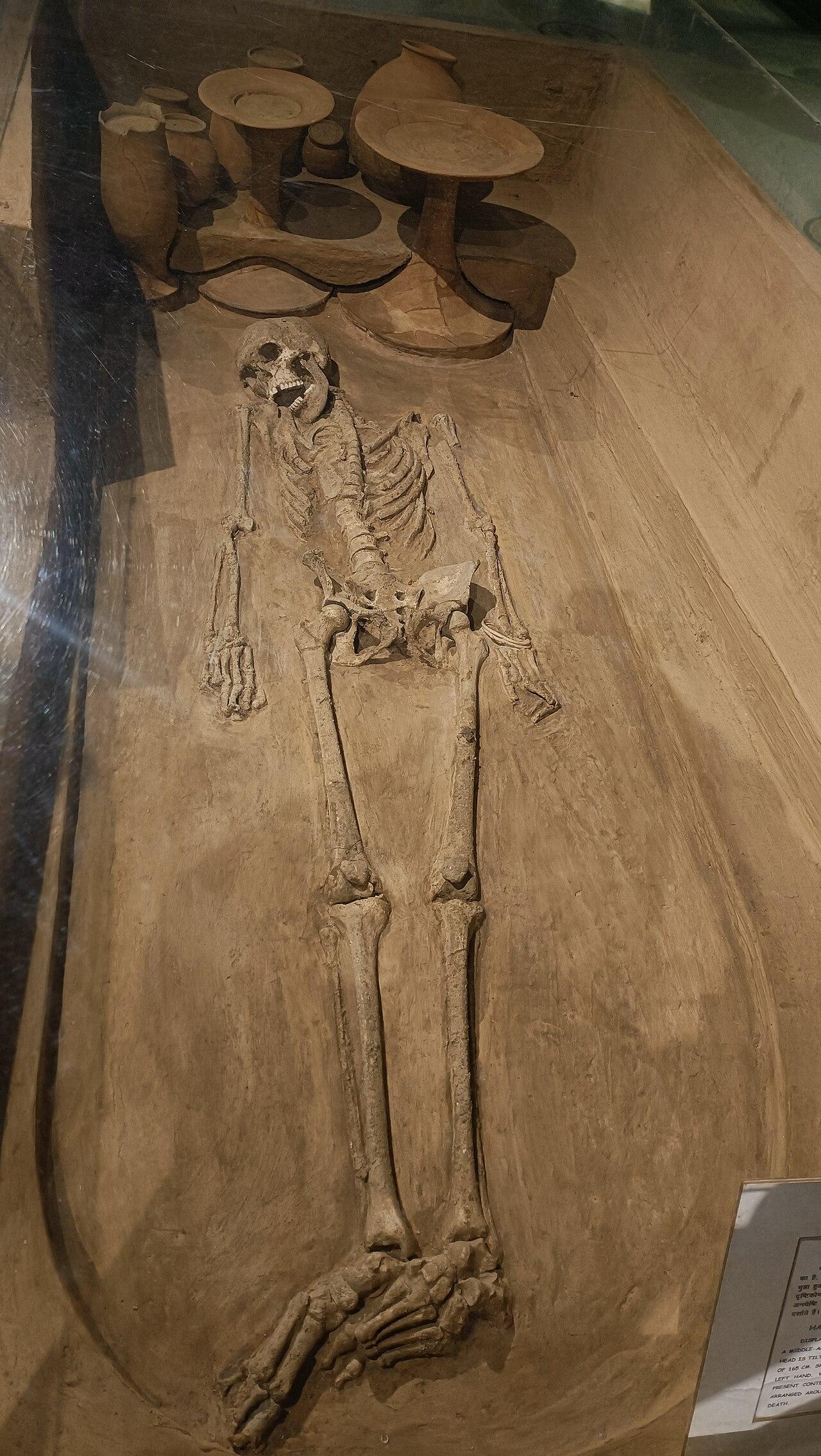
A Mesolithic camp on an ox-bow lake in the Ganga plain with some of the earliest human burials known from South Asia — a key site for the foragers who lived in the region before farming.
- 03Concept
AASI-related ancestry
An ancestry inferred, never sampled.
A modelled ancestry component distantly related to present-day Andamanese and other East Asian and Australasian lineages, inferred as a deep source in South Asian populations.
- 04Concept
Indus Periphery-related ancestry
The Indus-related genomes.
A genetic gradient defined by individuals with Iranian-related and AASI-related ancestry, observed directly in ancient genomes from Rakhigarhi and from Indus-associated migrants found in Iran and Central Asia.
- 05Concept2nd millennium BCE(Approximate)
The Indo-Aryan migration
Language, DNA and a debate.
The model that Indo-Aryan languages entered South Asia from Central Asia in the 2nd millennium BCE, carried by people with steppe-related ancestry who mixed with existing populations — not an 'invasion' or a single event.
- 06Sitec. 1400 – 800 BCE (main phase)(Approximate)
Swat protohistoric graveyards
Where steppe ancestry is first seen.
Cemeteries in the Swat valley of the late 2nd and early 1st millennia BCE whose individuals provided direct ancient-DNA evidence for steppe-related ancestry in South Asia.
- 07Sitec. early 2nd millennium BCE (debated)(Debated)
Sinauli (Sanauli)
Chariots or carts?
A cemetery near Delhi where excavations from 2005 and 2018 found burials with copper objects, a wooden coffin decorated with copper, and the remains of solid-wheeled vehicles. Their interpretation is strongly debated.
- 08ConceptTiming debated(Debated)
Austroasiatic (Munda) ancestry
Munda languages and Southeast Asian ancestry.
Munda-speaking groups of eastern and central India speak Austroasiatic languages related to those of mainland Southeast Asia, and carry ancestry from a related East/Southeast Asian source mixed with South Asian ancestry.
- 09Conceptlate 1st millennium BCE – 1st millennium CE(Debated)
Austronesian maritime contacts
Seafarers of the Indian Ocean.
Austronesian-speaking seafarers from Island Southeast Asia crossed the Indian Ocean by the 1st millennium CE, settling Madagascar and leaving traces in South Asian boats, crops and vocabulary.
The Map Check
Places in this collection
Sources & Further Reading
Sources & further reading
- journal articleWedage, O. et al. (2019). Specialized rainforest hunting by Homo sapiens ~45,000 years ago. Nature Communications 10: 739. doi:10.1038/s41467-019-08623-1
- bookDeraniyagala, S. U. (1992). The Prehistory of Sri Lanka: An Ecological Perspective. Department of Archaeological Survey, Colombo.
- excavation reportSharma, G. R., Misra, V. D., Mandal, D., Misra, B. B. & Pal, J. N. (1980). Beginnings of Agriculture: Epi-Palaeolithic to Neolithic — Excavations at Chopani-Mando, Mahadaha and Mahagara. Abinash Prakashan, Allahabad.record unverified
- bookKennedy, K. A. R. (2000). God-Apes and Fossil Men: Paleoanthropology of South Asia. University of Michigan Press.
- bookConingham, R. & Young, R. (2015). The Archaeology of South Asia: From the Indus to Asoka, c. 6500 BCE–200 CE. Cambridge University Press.
- journal articleNarasimhan, V. M. et al. (2019). The formation of human populations in South and Central Asia. Science 365(6457): eaat7487. doi:10.1126/science.aat7487
- journal articleShinde, V. et al. (2019). An Ancient Harappan Genome Lacks Ancestry from Steppe Pastoralists or Iranian Farmers. Cell 179(3): 729–735. doi:10.1016/j.cell.2019.08.048
- bookAnthony, D. W. (2007). The Horse, the Wheel, and Language: How Bronze-Age Riders from the Eurasian Steppes Shaped the Modern World. Princeton University Press.
- bookBryant, E. (2001). The Quest for the Origins of Vedic Culture: The Indo-Aryan Migration Debate. Oxford University Press.
- journal articleWitzel, M. (1995). Early Sanskritization: Origins and Development of the Kuru State. Electronic Journal of Vedic Studies 1(4).
- bookParpola, A. (2015). The Roots of Hinduism: The Early Aryans and the Indus Civilization. Oxford University Press.
- bookPossehl, G. L. (2002). The Indus Civilization: A Contemporary Perspective. AltaMira Press.
- excavation reportStacul, G. (1987). Prehistoric and Protohistoric Swāt, Pakistan (c. 3000–1400 B.C.). IsMEO.record unverified
- journal articleParpola, A. (2020). Royal 'Chariot' Burials of Sanauli near Delhi and Archaeological Correlates of Prehistoric Indo-Iranian Languages. Studia Orientalia Electronica 8(1): 176–195.record unverified
- journal articleChaubey, G. et al. (2011). Population genetic structure in Indian Austroasiatic speakers: the role of landscape barriers and sex-specific admixture. Molecular Biology and Evolution 28(2): 1013–1024. doi:10.1093/molbev/msq288
- journal articleTätte, K. et al. (2019). The genetic legacy of continental scale admixture in Indian Austroasiatic speakers. Scientific Reports 9: 3818. doi:10.1038/s41598-019-40399-8record unverified
- bookHoogervorst, T. (2013). Southeast Asia in the Ancient Indian Ocean World. BAR International Series 2580. Archaeopress.
- journal articleFuller, D. Q., Boivin, N., Hoogervorst, T. & Allaby, R. (2011). Across the Indian Ocean: the prehistoric movement of plants and animals. Antiquity 85(328): 544–558.
- journal articlePierron, D. et al. (2017). Genetic history of Madagascar. Proceedings of the National Academy of Sciences 114(32): E6498–E6506. doi:10.1073/pnas.1704906114record unverified