Empire
Gupta Empire
Also: Guptas · Gupta dynasty
A dynasty of the Ganga valley whose kings, through conquest, tribute and marriage alliance, dominated north India from the 4th to the 6th century CE.
The Map Check
Geographic extent
Largest recorded extent, from Cliopatria (Seshat Global History Databank, CC BY 4.0) — drawn as published. Open the atlas to see how it changed over time. Points are the places Indophile uses to locate the polity.
Rulers & important personalities
- Chandragupta Ic. 319 – 335 CE(Approximate)
Gupta era reckoned from 319/320 CE.
- c. 335 – 375 CE(Approximate)
- c. 375 – 415 CE(Approximate)
- Kumaragupta Ic. 415 – 455 CE(Approximate)
- Skandaguptac. 455 – 467 CE(Approximate)
The Historical Record
The historical record
EstablishedInscriptions, texts, coins and other primary sources
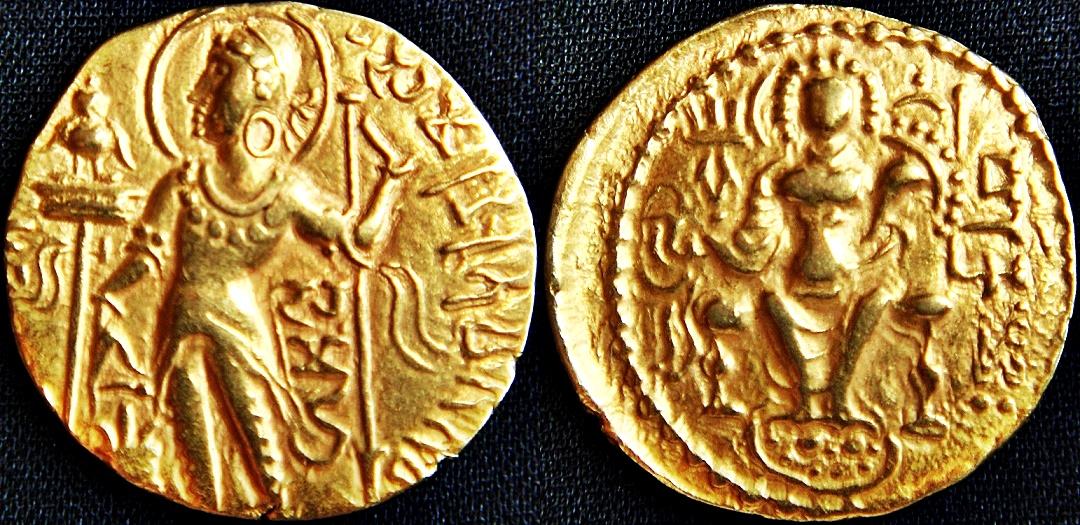
Gupta history rests on inscriptions — especially Harishena's eulogy of Samudragupta on the Allahabad pillar — on an extensive gold coinage, and on the account of the Chinese pilgrim Faxian, who travelled in the reign of Chandragupta II.
SourcesFleet 1888; Legge 1886
A 'golden age'?
Well supportedOlder historiography called the Gupta period a 'golden age'. Historians now treat the label cautiously: it reflects the priorities of particular nationalist and colonial-era narratives, and the period's achievements were shared with contemporaries such as the Vakatakas.
SourcesThapar 2002; Singh 2008
Material culture
Important artefacts
Connected to Gupta Empire
The wider world of this polity
Samudragupta
Gupta king whose campaigns and claimed tributaries are recorded in Harishena's eulogy on the Allahabad pillar.
Chandragupta II
Gupta king who extended Gupta power into western India; Faxian travelled through his realm.
Faxian
Chinese Buddhist monk who travelled through South Asia c. 399–414 CE in search of monastic texts.
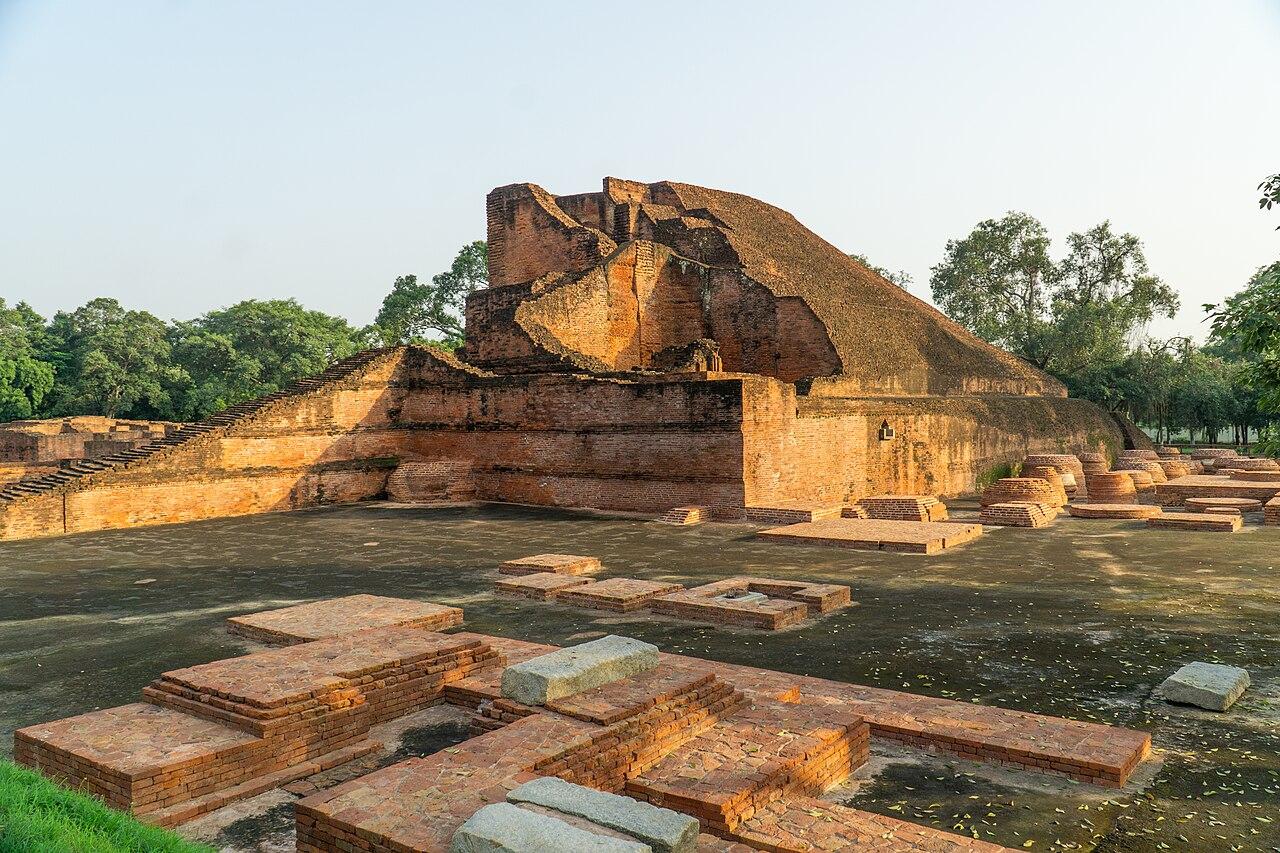
Nalanda Mahavihara
A great Buddhist monastic university that flourished from the Gupta period to the 12th century, visited by the Chinese pilgrim Xuanzang.
Udayagiri Caves (Vidisha)
Rock-cut shrines near Vidisha with a monumental Varaha panel and an inscription dated in the reign of Chandragupta II.
Aryabhata
Mathematician-astronomer whose Aryabhatiya (499 CE) treats arithmetic, algebra, trigonometry and planetary astronomy.
Allahabad (Prayagraj) Pillar
An Ashokan pillar later inscribed with Harishena's eulogy of Samudragupta and, much later, a Persian inscription of Jahangir.
Gold coin of Samudragupta
A gold dinara of the 'javelin' (standard) type, showing the king holding a standard and making an offering at an altar.
Sources & Further Reading
Sources & further reading
- inscription corpusFleet, J. F. (1888). Inscriptions of the Early Gupta Kings and their Successors. Corpus Inscriptionum Indicarum, Vol. III. Government of India.
- bookSingh, U. (2008). A History of Ancient and Early Medieval India: From the Stone Age to the 12th Century. Pearson Longman.
- bookThapar, R. (2002). Early India: From the Origins to AD 1300. Allen Lane / University of California Press.
- primary sourceLegge, J. (trans.) (1886). A Record of Buddhistic Kingdoms: Being an Account by the Chinese Monk Fâ-Hien of his Travels in India and Ceylon (A.D. 399–414). Clarendon Press.