Curated collection · 8 entries
Understanding Ancient Indian DNA
Archaeogenetics has transformed the study of South Asian population history. This collection explains the main findings and, just as importantly, their limits.
Curated by Indophile Editorial
- 01Genetic study2009 CE(Secure date)
Reconstructing Indian population history
The ANI–ASI model.
Introduced the 'Ancestral North Indian' (ANI) and 'Ancestral South Indian' (ASI) model to describe genetic variation among present-day Indian groups.
- 02Concept
ANI and ASI
Why ANI and ASI are models, not peoples.
Two statistical reference populations proposed in 2009 to describe the main axis of genetic variation among present-day Indians.
- 03Genetic study2013 CE(Secure date)
Genetic evidence for recent population mixture in India
Dating mixture and endogamy.
Dated ANI–ASI admixture in present-day Indian groups to between about 1,900 and 4,200 years ago, followed by a reduction in mixing consistent with endogamy.
- 04Genetic study2019 CE(Secure date)
The formation of human populations in South and Central Asia
523 ancient individuals.
A large ancient DNA study proposing how ancestry related to Iranian-plateau groups, AASI and steppe pastoralists combined to form South Asian populations.
- 05Genetic study2019 CE(Secure date)
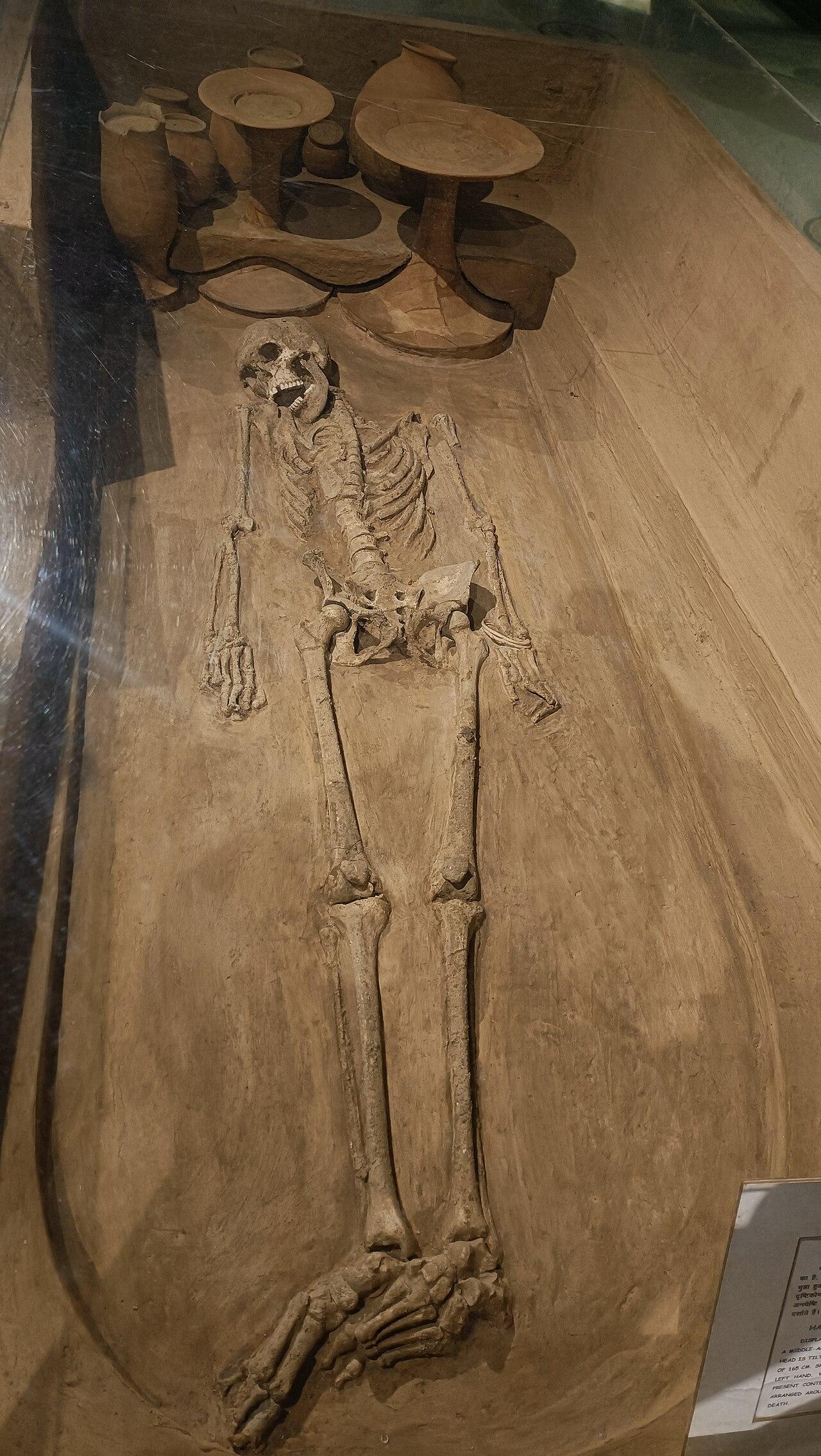
An Ancient Harappan Genome Lacks Ancestry from Steppe Pastoralists or Iranian Farmers
The Rakhigarhi genome.
The first published genome from an individual buried in an Indus civilisation cemetery.
- 06Concept
Indus Periphery-related ancestry
The Indus Periphery Cline.
A genetic gradient defined by individuals with Iranian-related and AASI-related ancestry, observed directly in ancient genomes from Rakhigarhi and from Indus-associated migrants found in Iran and Central Asia.
- 07Concept
Steppe pastoralist-related ancestry
Ancestry is not language.
Ancestry related to Middle–Late Bronze Age populations of the Eurasian steppe, detected in Swat valley genomes by the late 2nd millennium BCE.
- 08Concept
Haplogroups and uniparental lineages
One line among thousands.
Maternal (mtDNA) and paternal (Y-chromosome) lineages trace a single line of descent each — useful for sex-biased history, but a tiny part of anyone's ancestry.
Sources & Further Reading
Sources & further reading
- journal articleReich, D., Thangaraj, K., Patterson, N., Price, A. L. & Singh, L. (2009). Reconstructing Indian population history. Nature 461: 489–494. doi:10.1038/nature08365
- journal articleNarasimhan, V. M. et al. (2019). The formation of human populations in South and Central Asia. Science 365(6457): eaat7487. doi:10.1126/science.aat7487
- journal articleMoorjani, P. et al. (2013). Genetic evidence for recent population mixture in India. American Journal of Human Genetics 93(3): 422–438. doi:10.1016/j.ajhg.2013.07.006
- journal articleShinde, V. et al. (2019). An Ancient Harappan Genome Lacks Ancestry from Steppe Pastoralists or Iranian Farmers. Cell 179(3): 729–735. doi:10.1016/j.cell.2019.08.048
- journal articleSilva, M. et al. (2017). A genetic chronology for the Indian Subcontinent points to heavily sex-biased dispersals. BMC Evolutionary Biology 17: 88. doi:10.1186/s12862-017-0936-9