Subject
Ancient DNA
Archaeogenetics of South Asia, with its evidence and its limits.
22 connected entries
Articles · 1
Sites · 3
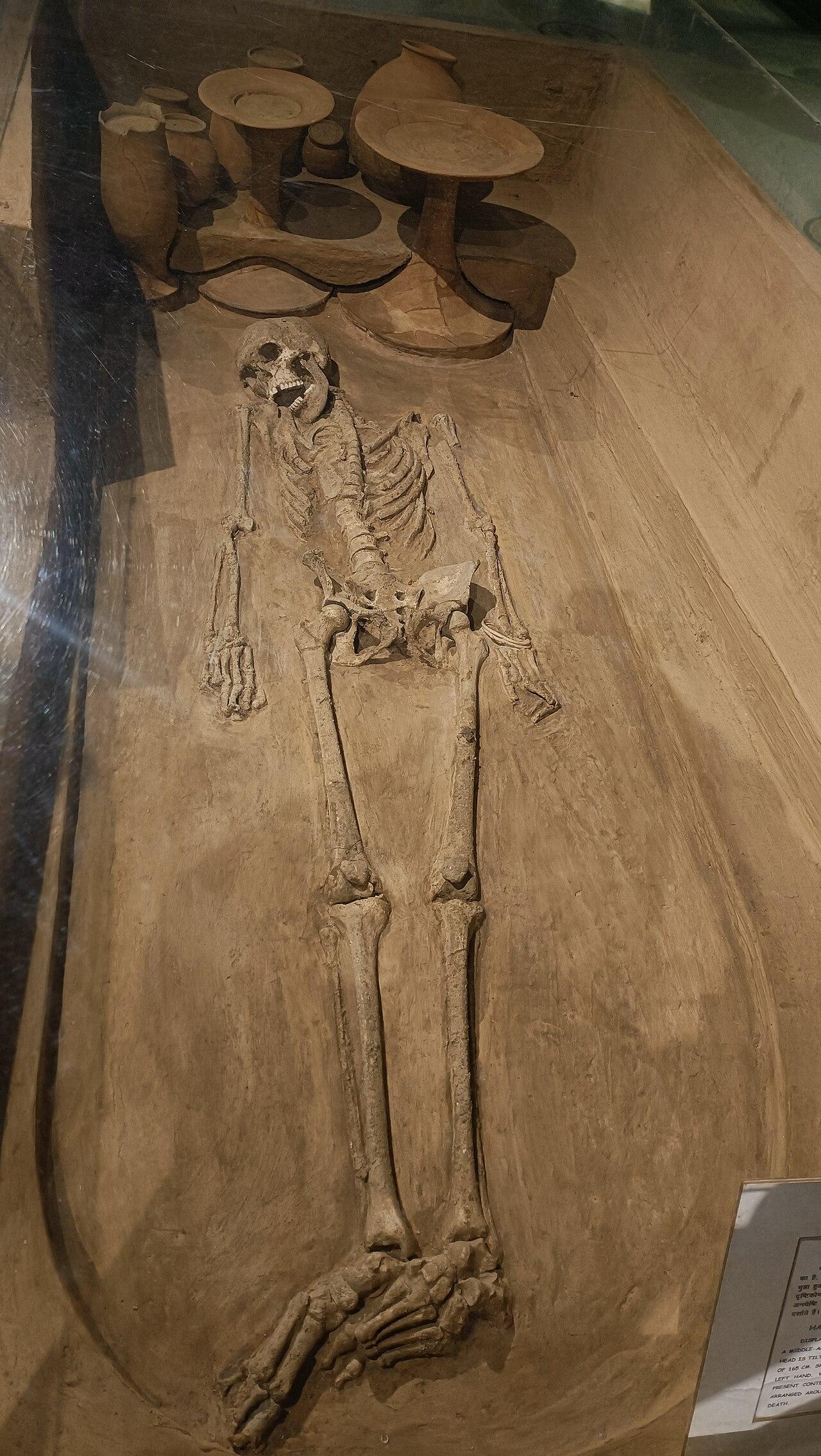
Rakhigarhi
One of the largest Harappan settlements, in the Ghaggar basin of Haryana. Its cemetery produced the first published ancient genome from an Indus-associated individual.
Swat protohistoric graveyards
Cemeteries in the Swat valley of the late 2nd and early 1st millennia BCE whose individuals provided direct ancient-DNA evidence for steppe-related ancestry in South Asia.
Gonur Depe
A Bronze Age walled centre of the Bactria–Margiana Archaeological Complex (BMAC), where several individuals with Indus Periphery-related ancestry were found.
Genetic studys · 5
Reconstructing Indian population history
Introduced the 'Ancestral North Indian' (ANI) and 'Ancestral South Indian' (ASI) model to describe genetic variation among present-day Indian groups.
Genetic evidence for recent population mixture in India
Dated ANI–ASI admixture in present-day Indian groups to between about 1,900 and 4,200 years ago, followed by a reduction in mixing consistent with endogamy.
The formation of human populations in South and Central Asia
A large ancient DNA study proposing how ancestry related to Iranian-plateau groups, AASI and steppe pastoralists combined to form South Asian populations.
An Ancient Harappan Genome Lacks Ancestry from Steppe Pastoralists or Iranian Farmers
The first published genome from an individual buried in an Indus civilisation cemetery.
A genetic chronology for the Indian Subcontinent points to heavily sex-biased dispersals
Compared maternal (mtDNA) and paternal (Y-chromosome) lineages and argued that Bronze Age dispersals into South Asia were strongly male-biased.
Concepts · 9
AASI-related ancestry
A modelled ancestry component distantly related to present-day Andamanese and other East Asian and Australasian lineages, inferred as a deep source in South Asian populations.
Iranian-related ancient ancestry
Ancestry related to ancient hunter-gatherers and farmers of the Iranian plateau. In South Asian contexts it appears from a lineage that may have separated from sampled Iranian groups early.
Indus Periphery-related ancestry
A genetic gradient defined by individuals with Iranian-related and AASI-related ancestry, observed directly in ancient genomes from Rakhigarhi and from Indus-associated migrants found in Iran and Central Asia.
Steppe pastoralist-related ancestry
Ancestry related to Middle–Late Bronze Age populations of the Eurasian steppe, detected in Swat valley genomes by the late 2nd millennium BCE.
ANI and ASI
Two statistical reference populations proposed in 2009 to describe the main axis of genetic variation among present-day Indians.
Endogamy and population structure
Marriage within a group over many generations produces genetic structure — strong founder effects that are visible in genomic data.
Haplogroups and uniparental lineages
Maternal (mtDNA) and paternal (Y-chromosome) lineages trace a single line of descent each — useful for sex-biased history, but a tiny part of anyone's ancestry.
The Indo-Aryan migration
The model that Indo-Aryan languages entered South Asia from Central Asia in the 2nd millennium BCE, carried by people with steppe-related ancestry who mixed with existing populations — not an 'invasion' or a single event.
Austroasiatic (Munda) ancestry
Munda-speaking groups of eastern and central India speak Austroasiatic languages related to those of mainland Southeast Asia, and carry ancestry from a related East/Southeast Asian source mixed with South Asian ancestry.
Routes · 4
Steppe-related ancestry into South Asia (model)
Schematic arrow for the arrival of steppe pastoralist-related ancestry, observed in Swat valley genomes by the late 2nd millennium BCE.
Indus Periphery migrants to Iran and Turan (observed)
Individuals with Indus Periphery-related ancestry found at Shahr-i Sokhta and Gonur indicate movement out of the Indus world in the 3rd millennium BCE.
Formation of ASI-related ancestry (model)
Schematic: Narasimhan et al. model ASI as Indus Periphery-related ancestry mixing with AASI-related groups, likely after Indus deurbanisation.
Austroasiatic ancestry into eastern India (model)
Schematic arrow for the Southeast Asian-related ancestry found in Munda-speaking groups; timing and route are debated.